The Practice
How the photograph is made, how bids reach the image, how the auction runs and what the buyer receives.
The Eternal Return
One work in recurring cycles. Each cycle ends; the work does not.
- Philosophy
Grounded in Nietzsche's eternal return (ewige Wiederkunft): time not as progress but as an unending cycle of repetition, consumption, death and return.
- The feedback loop
The market does not price a finished object; it produces the work. Competition writes light into the plate, buys the scarred remnant and returns three months later for the next.
- The system
The artwork is the system: the auction rules, the mapping from each bid to light, and the pipeline that carries one week's ledger into one print. The photograph is its material. The print is its record.
- A single unending work
Each quarterly 1-of-1 print is one seven-day state of a work that never closes. Each collector holds one moment of its recurrence.
- Death & return
Every winning print records the erasure of that evening's horizon. Only zero bids leave the Day 0 ocean intact: archived as Unclaimed, never printed.
- Lineage
Eternal Return began in 2019 as an algorithmic painting work in which each auction bid spawned a brush working across a canvas for seven days. Early iterations were exhibited in London and Singapore. Since then the work has shed synthetic gesture for photography—returning to a real ocean dusk, captured digitally, where every bid leaves a trace of light rather than paint.
The Subject
The sea was returning long before the camera arrived.
- The ocean
The ocean is the earth's vastest eternal return: swell, collapse, evaporation and tide against the same unbroken horizon, never the same wave twice.
- Two loops
Nature's indifferent recurrence meets the market's loop of desire, consumption and erasure. The first is photographed; the second is written into the photograph.
- Return
The sea returns, indifferent. Only desire enters the image, and it leaves its scar.
Fixed Coordinates & Ritual
The same place, framing and hour of light. Only the sea and the market change.
- Place
Ballito, KwaZulu-Natal, South Africa. 29.539° S, 31.214° E. The camera faces the Indian Ocean horizon.
- Framing
The horizon sits on the centre line: half sky, half sea. Camera position and framing never change between auctions.
- Exposure
One digital capture at the last dusk before each solstice or equinox: the Day 0 plate, never retaken or edited.
Bidding opens at the astronomical instant that follows: for the March Equinox 2027, dusk on 20 March and the room that night at 20:25 UTC (22:25 SAST). When the instant falls in daylight or before dawn, the plate is the previous evening's.
- Cadence
Four a year: March Equinox, June Solstice, September Equinox, December Solstice. Each runs seven days from the astronomical instant, to the minute.
For the other 337 days of the year, nothing is for sale.
March Equinox 2027
- Exposed
- Dusk, 20 Mar 2027
- Opens
- 20 Mar 2027 · 20:25 UTC (22:25 SAST)
- Closes
- 27 Mar 2027 · 20:25 UTC
June Solstice 2027
- Exposed
- Dusk, 20 Jun 2027
- Opens
- 21 Jun 2027 · 14:11 UTC (16:11 SAST)
- Closes
- 28 Jun 2027 · 14:11 UTC
September Equinox 2027
- Exposed
- Dusk, 22 Sep 2027
- Opens
- 23 Sep 2027 · 06:02 UTC (08:02 SAST)
- Closes
- 30 Sep 2027 · 06:02 UTC
December Solstice 2027
- Exposed
- Dusk, 21 Dec 2027
- Opens
- 22 Dec 2027 · 02:42 UTC (04:42 SAST)
- Closes
- 29 Dec 2027 · 02:42 UTC
The System & Its Stocks
The photograph is a single digital capture. For seven days the system holds it open and writes every bid into it as a measured amount of light. What is written cannot be undone.
- The capture
A digital capture of the dusk in full colour at 16 bits: Canon EOS 5DS, 50.6 megapixels, daylight white balance, its own colour profile honoured. The system meters each file the same way every time, so the unlit sea stays faithful to that evening's light.
- Not the seasons
The stock is not tied to the seasons, which would repeat the same four looks every year. Each auction's opening bid — its exact moment, its bidder and its amount — selects one of six stock profiles for that seven-day cycle, together with a spatial architecture for its light: vertical, lateral or corner.
Nothing after the opening bid is consulted. The choice has no lookahead and is strictly deterministic.
- Six stocks
Each stock is a modelled photographic behaviour, computed on the digital plate: a tonal response, a colour character, a grain and a way of degrading. Each takes its structure from the history of photographic film.
Tungsten / Viridian Fog. Medium-coarse C-41 grain and soft, lifted shadows. Viridian fog and sulphur-gold burns.
Silver-Ash & Rust. Gritty high-speed grain. Dry, matte graphite with oxidized rust streaks.
Remjet Halation. Fine-to-medium tungsten cinema grain, velvety soot blacks, scarlet-copper seams with a red halation glow.
Midnight Shutter. Ultra-fine E-6 reversal grain and a steep curve. Crisp cobalt and silver-white leaks, with no warm tone at all.
Expired Cross-Process. Aged, mottled grain. Deep oxblood, burgundy and bruised plum-violet.
Silver-Gelatin B&W, pushed to 3200. Heavy, clumped silver-halide grain. Crushed selenium blacks bleaching straight to raw alabaster white.
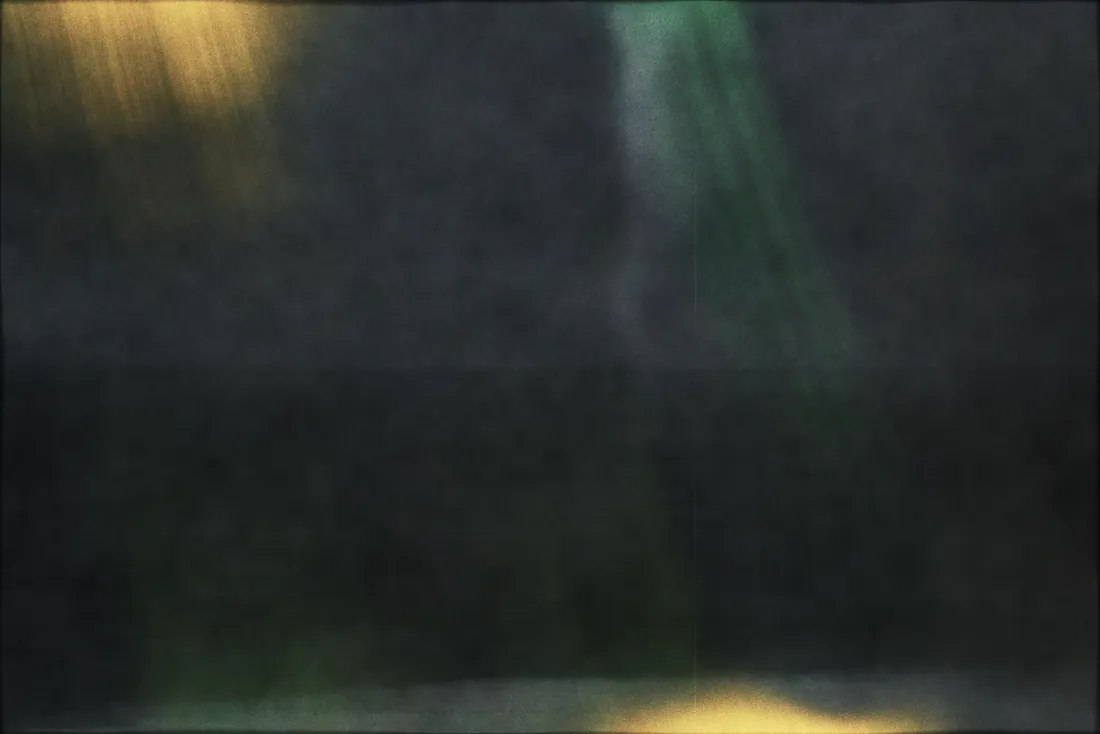 Tungsten / Viridian FogQuiet D
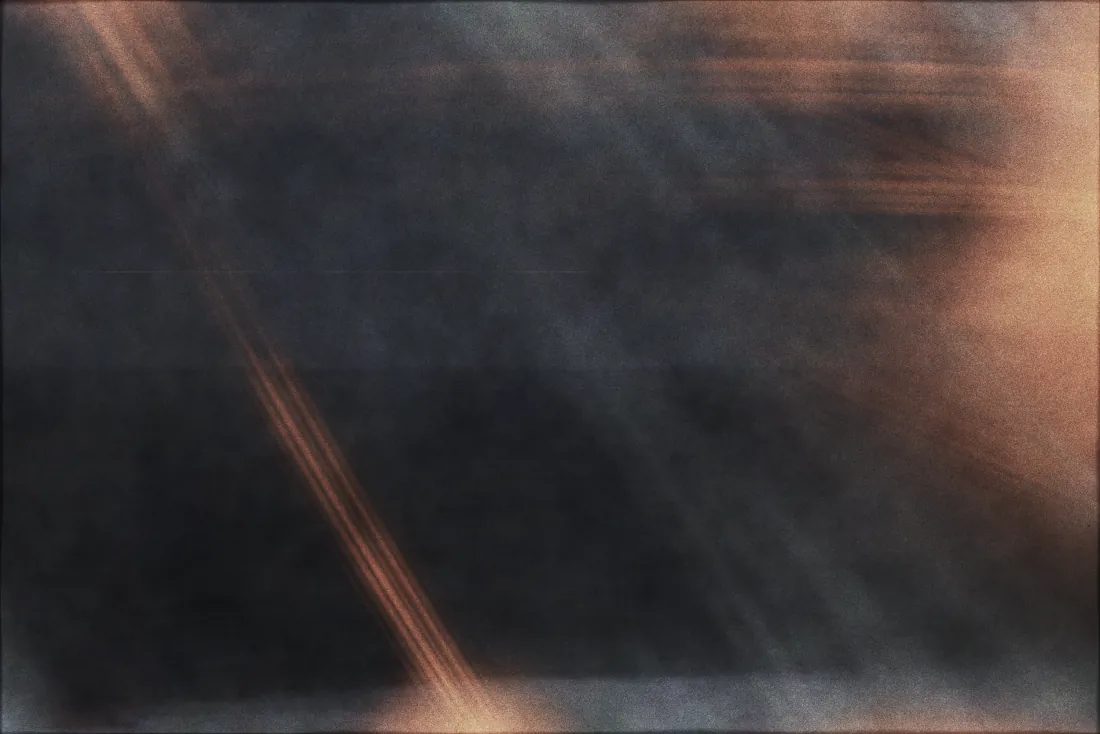 Silver-Ash & RustNormal E
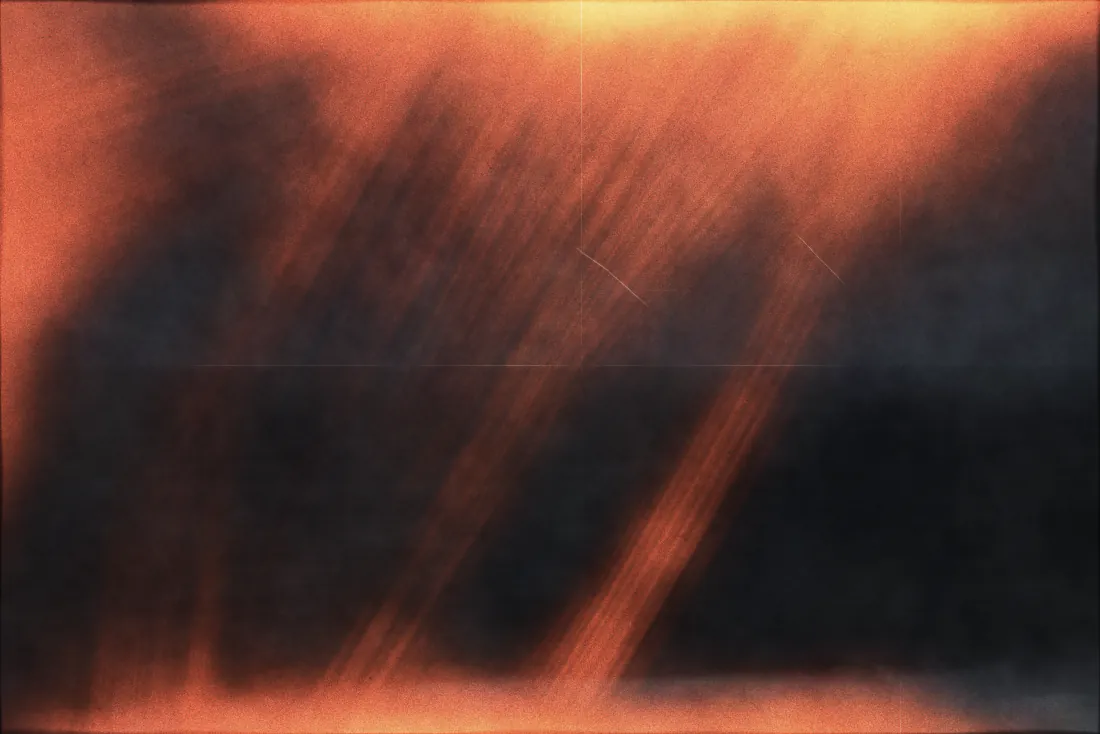 Remjet HalationFrenzy F
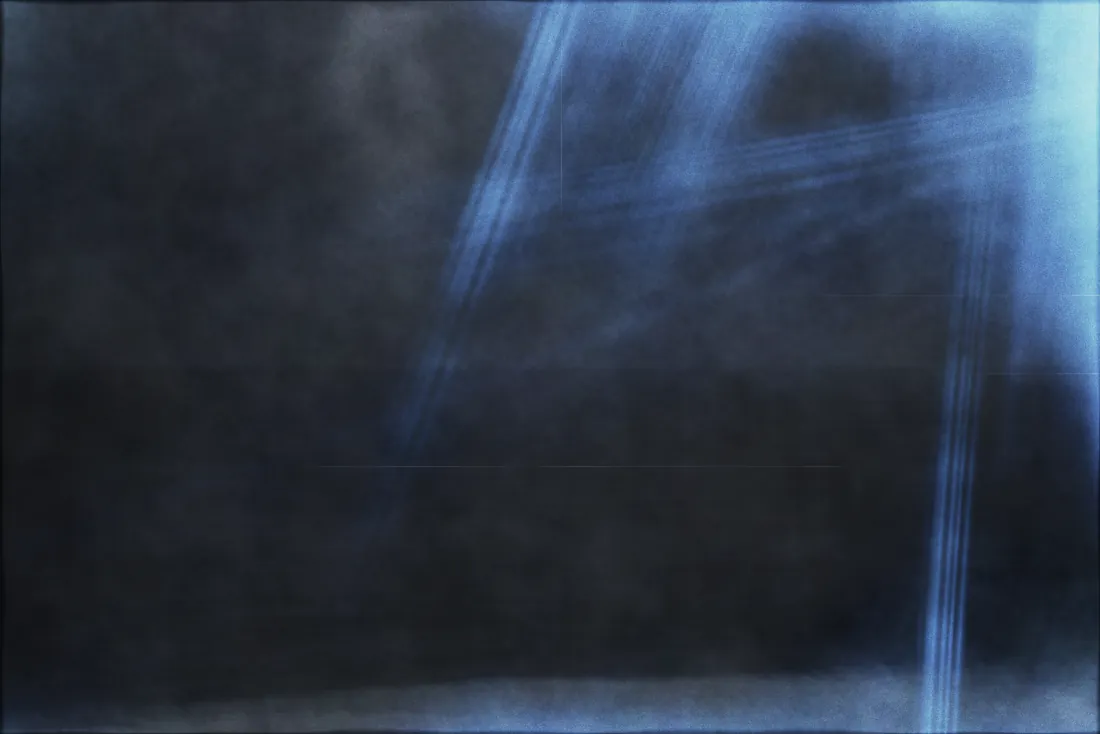 Midnight ShutterNormal G
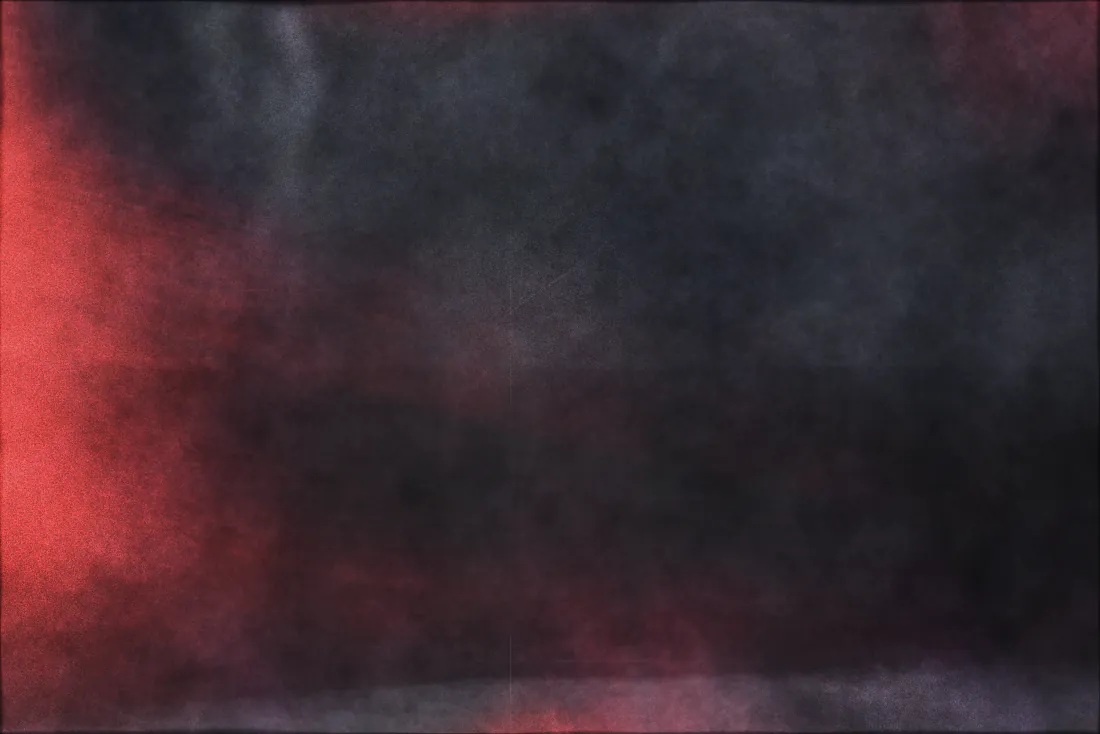 Expired Cross-ProcessNormal H
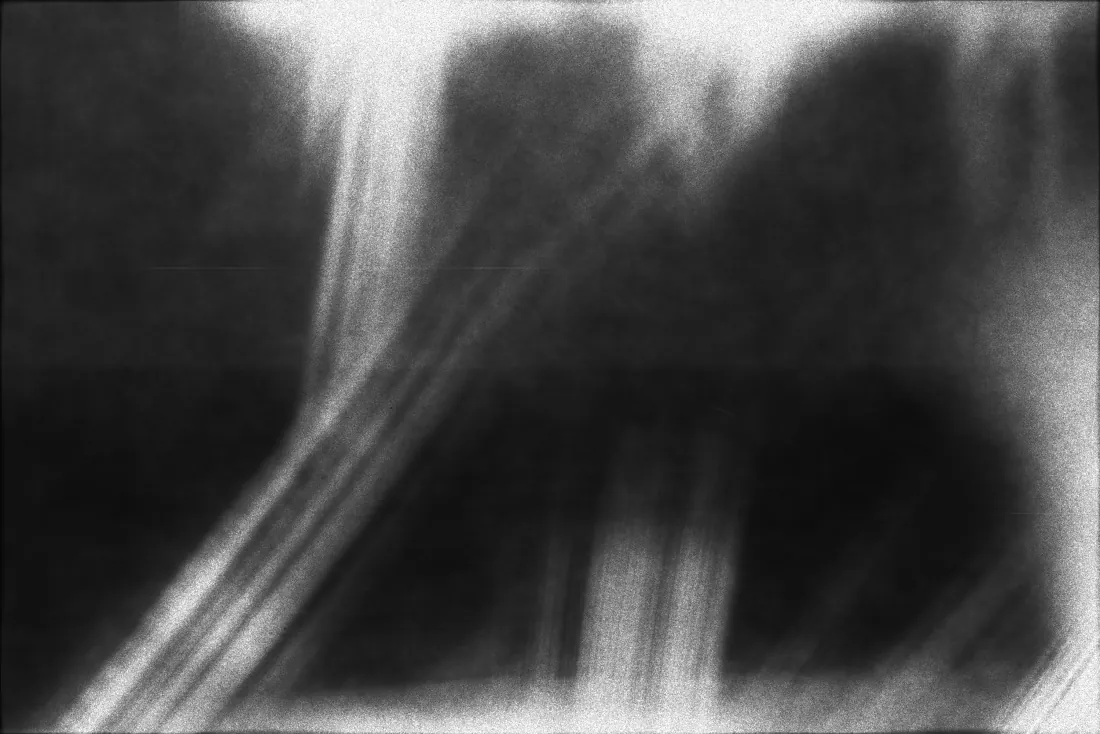 Silver-Gelatin B&W · Pushed 3200Normal I
Calibration Studies · one 5DS digital dusk capture · simulated bid logs · not for sale
- Restraint
Every print stays within two or three tones. Across auctions the archive spans a wide and unpredictable photographic range. A stock is not a grade laid on top: it decides which colour layer the light reaches first, the response curve, the grain and the colour of the fog.

Normal E · Silver-Ash & Rust · grain at 1:11200 × 800 px of the 9000 × 6000 print master · 20 × 13 cm of the print · not resampled - The faithful plate
Where no light is written, the plate holds the Day 0 dusk as the camera recorded it. The stock asserts itself only where light gets in. The silver stock is the exception: monochrome across the whole plate.
- Time and place
When a bid lands sets where its light enters along the edge of the frame: the week runs left to right. A bid after a long silence is a broad, soft fog; a bid in a flurry is a narrow, hotter burn. The size of a jump sets strength and reach. A reply to a rival lands over the rival's light and builds a brighter seam.
- Modelled artefacts
The system also models a restrained set of camera artefacts, all governed by the ledger. In about half of all auctions a lagging shutter curtain lets the scene fall away at one end of the frame. Where an edge burns hot, soft perforation light bleeds along it. A bid after a day or more of silence leaves faint bromide drag hanging from the top edge. Each bidding war leaves one hairline scratch.
- Reproducibility
The same bid log always produces the same image, byte for byte, on every re-render. Every trace of light depends only on its own bid and the bids before it. Nothing is chosen by hand and no randomness is added at print time.
Auction Rules & the Unclaimed Plate
Seven days, a fixed close and one buyer. Silence is also a result.
- Window
The auction opens at the instant of the solstice or equinox and closes exactly seven days later, to the minute. Auction #01 opens on Saturday 20 March 2027 at 20:25 UTC (22:25 SAST) and closes on Saturday 27 March 2027 at 20:25 UTC.
- Increments
The minimum step rises with the price: $25 under $1,000; $50 from $1,000; $100 from $2,500; $250 from $10,000. Any bid may exceed the minimum. The schedule for Auction #01, including the opening bid and any reserve, will be published before it opens.
- Closing
The close is never extended. Late bidding is not penalised; it is recorded. A contest in the closing hours enters through the right-hand edge and, under real pressure, burns hot there. A quiet close leaves only an ember.
- Binding bids
Only registered collectors may bid, each with a card verified before the auction opens. Bids above $10,000 need prior approval. A bid is binding the moment the ledger records it, and its light is written into the plate at once. It cannot be undone.
If the winning collector does not pay, the sheet is offered to the underbidder at their own last bid. If that offer is declined, the sheet is archived as Defaulted and never printed. No bid is ever removed from the ledger.
- Unclaimed
If the seven days close with no bids, the untouched Day 0 horizon survives unmarked. It is archived permanently as Unclaimed and is never printed.
| Current price | Minimum step |
|---|---|
| Under $1,000 | $25 |
| $1,000 to $2,499 | $50 |
| $2,500 to $9,999 | $100 |
| $10,000 and above | $250 |
Schedule used by the Calibration Studies · Auction #01 schedule to be published
Edition, Provenance & Shipping
One sheet, one print, one owner.
- Object
A unique archival pigment print, 150 × 100 cm, on Hahnemühle Photo Rag Baryta (315 gsm), printed from a 16-bit Adobe RGB master. It is inspected and signed on the verso in archival pencil by the artist. No other print of the sheet is made.
- Provenance
The print is accompanied by the complete auction provenance ledger, signed and archival: the capture's exposure metadata, the opening bid that selected the stock and the full bid history of the week. With it come a signed Certificate of Authenticity and a Framing Specification Sheet giving the recommended moulding, archival mount and museum glazing.
- Delivery
Delivered unframed, rolled on a wide-diameter archival core inside a heavy-duty tube. International shipping is billed separately at cost. Framing is available on request.
- Edition
- Unique. One of one. No other print of the sheet is ever made.
- Dimensions
- 150 × 100 cm
- Medium
- Archival pigment print on Hahnemühle Photo Rag Baryta, 315 gsm
- Master
- Printed from a 16-bit Adobe RGB (1998) master file
- Signature
- Inspected and signed on the verso in archival pencil by the artist
- Delivery
- Unframed, rolled on a wide-diameter archival core inside a heavy-duty tube
- Shipping
- International. Billed separately at cost
- Framing
- Available on request
See the rules applied to one real dusk capture and seven simulated weeks in the Calibration Studies.
One email when the room opens.
Four auctions a year, plus notice ahead of Auction #01. One email as each window opens, with the Day 0 plate. Never shared.